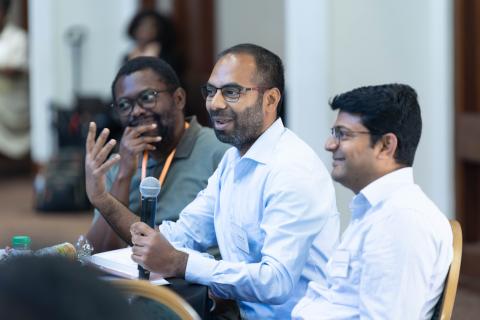
Postdoctoral scholars at The University of Texas at Austin are driving innovation by bringing new techniques, ideas and solutions through their research and by partnering with local communities, government and industry.
They also advance the University’s teaching mission by working closely with undergraduate and graduate students and serving as team leaders and mentors.
Postdoc Profiles
Frank Gao (he/him)
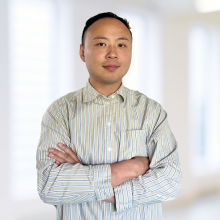
Postdoctoral Fellow | Texas Quantum Institute
As an inaugural Texas Quantum Institute postdoctoral fellow in the Department of Physics, Frank Gao recently co-authored a groundbreaking paper on ultrafast magnetism with Assistant Professor Edoardo Baldini, which was awarded the 2026 Research Paper Excellence Award.
“I am deeply passionate about science, research, and expanding the horizons of human knowledge for the betterment of society,” Gao said. “Quantum materials and ultrafast magnetism is a thriving research area, full of exciting potential for real-world applications.”
Khamron Micheals (he/him)
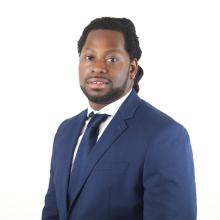
Postdoctoral Fellow | School of Social Work
Before attending UT Austin as a postdoctoral fellow, Khamron Micheals was a respiratory therapist at the bedside of critically ill patients in the Texas Medical Center. While caring for patients on the front lines, Micheals was also learning about the broader systems, such as housing, income and access to care, that influence sickness and recovery time.
Now a postdoctoral fellow in UT’s School of Social Work and Dell Medical School, Micheals’ current research focuses on understanding why some children experience worse asthma outcomes than their peers.
Kaitlyn Swinney (she/her)
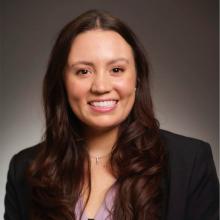
Postdoctoral Fellow | School of Social Work
A child’s walk to school is a great way to incorporate physical activity and cardiovascular fitness into their daily routine. However, in the United States, only about 11% of children currently walk or bike to school, according to the National Household Travel Survey. Kaitlyn Swinney, second-year postdoctoral fellow in the School of Social Work, wants to know why.
“Parents’ beliefs are strongly associated with whether their child actively commutes to school for elementary school children,” Swinney said. “Additionally, I have been looking at how access to environmental features like parks and sidewalk lengths (both associated with higher physical activity) differ by proportion of minority residents living in the area.”
Anjali Singh (she/her)
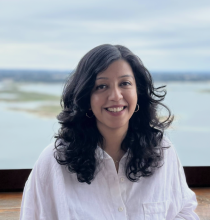
Postdoctoral Fellow | School of Information
“I have always been fascinated by what makes learning truly meaningful,” said Anjali Singh, Bullard Postdoctoral Fellow at the School of Information. “Deep and effective learning requires effort—making mistakes, learning from them and practicing regularly.”
Singh studies how to help students think more critically about the information generated by Generative AI (GenAI) tools. She recently conducted a study exploring how students use GenAI tools when presented with cues that encourage them to pause and reflect. She is now developing an AI tool that provides personalized cues to guide learners in becoming more thoughtful and intentional in their search process.
Carlos Morales-Aguilar (he/him)
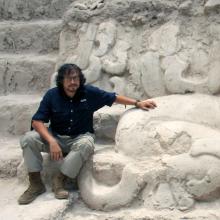
Postdoctoral Fellow | Department of Geography & the Environment
“The thought of stepping into the unknown, peeling back layers of history, exploring, and revealing ancient buildings that have been hidden beneath the forest canopy for centuries has always sparked my imagination.”
Carlos Morales-Aguilar, postdoctoral fellow in the Department of Geography and the Environment, uses cutting-edge technology to turn imagination into reality. As part of the UT LLAMA Lab, he uses LiDAR technology to generate 3D maps that reveal the landscapes of ancient civilizations. This allows the Lab to pinpoint areas of interest before they travel on-site to excavate.
Anna Bokun (she/her)
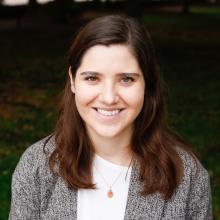
Postdoctoral Fellow | Population Research Center
Sociology and demography enable us to understand the hidden structures shaping our communities. Dr. Anna Bokun is a postdoctoral researcher at UT's Population Research Center, where she bridges data with theory to examine major life transitions—caregiving, fertility, and aging—to understand how families navigate financial and emotional challenges.
“Across all my work, I’m asking: How do families adapt to life’s biggest challenges?” Dr. Bokun said. “What policies help, or fail them? By studying these questions, I hope to inform solutions that support families' economic wellbeing across the life course. For example, many family caregivers face significant financial burdens, yet social policies often fail to recognize or support them adequately."
Alumni Profiles
Guillermo Lorenzo (he/him)
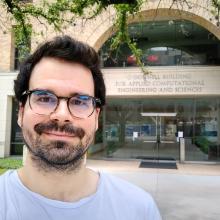
Ramon y Cajal Fellow | University of A Coruña
During his postdoctoral fellowship at the Oden Institute Center for Computational Oncology, Guillermo Lorenzo contributed to research that was awarded a 2026 President’s Research Impact Award. Lorenzo is now a Ramon y Cajal fellow at the University of A Coruña in Spain.
“The Ramon y Cajal fellowships are the most prestigious contracts for young established researchers from the Spanish Ministry of Science,” Lorenzo said. “I lead a team of researchers working in computational oncology within a larger research group devoted to numerical methods in engineering.”
Chengyue Wu (she/her)
Department of Imaging Physics | MD Anderson Cancer Center
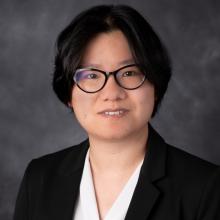
Before Chengyue Wu became a tenure-tracked Assistant Professor in the Department of Imaging Physics at MD Anderson Cancer Center, she was a postdoctoral fellow at the Oden Institute. The research she pursued in the Center for Computational Oncology recently received a 2026 President’s Research Impact Award.
“The mission of the Center is to build advanced image analysis methods and image-based modeling techniques to improve cancer diagnosis and response prediction,” Wu said. “During my postdoc, I broadened my research focus from cancer characterization to treatment guidance, applying advanced computational techniques to optimize treatment in various cancer types.”